The Essential Guide to Flag Icon Collections: Enhancing Global Communication with Vector Symbols
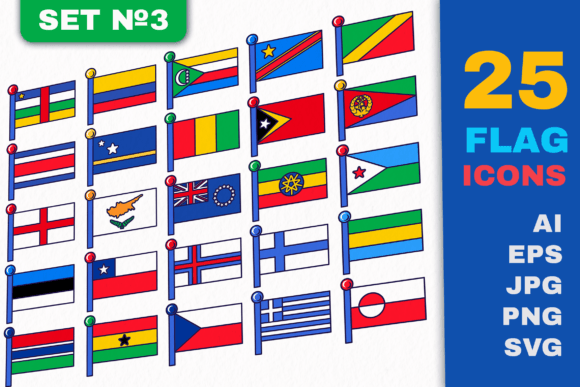
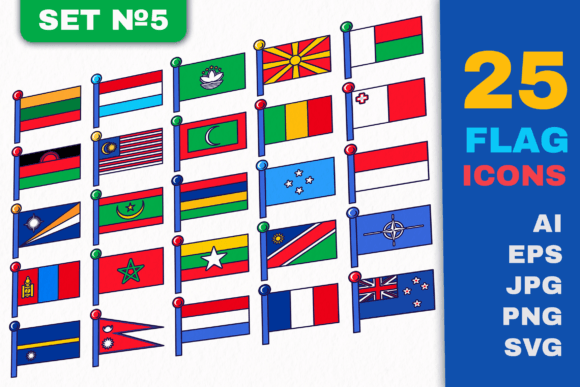
In our increasingly interconnected digital world, visual communication transcends language barriers. Among the most powerful and universally recognized visual symbols are national flags. They represent identity, culture, and geography in a single, concise emblem. For designers, developers, educators, and businesses needing to incorporate these symbols into their projects, specialized flag icon collections provide the perfect solution. This article explores the purpose, significance, and practical utility of modern flag icon sets, such as the comprehensive Flag Icons Set 5 and the dedicated 25 Flat Outline Flag Icons Collection, which cover a diverse array of nations from Lithuania to New Zealand.
What Are Flag Icon Collections and Why Are They Needed?
Flag icon collections are curated sets of digital vector graphics representing the flags of countries, territories, and organizations. Unlike a simple photograph or a complex illustration, these icons are designed as clean, scalable, and editable vector shapes. Their primary purpose is to offer a standardized, visually consistent way to denote nationality, location, or affiliation in a wide range of digital and print media. In a global context, whether you're marking user locations on an app, creating an infographic about international trade, or designing a travel website, using accurate and well-designed flag icons is crucial for clarity and professionalism.
Common misunderstandings include assuming that any flag image online is suitable for professional use. Many are low-resolution, have inconsistent dimensions, or are not licensed for commercial projects. A professional icon collection resolves these issues by providing a complete, legally usable, and technically optimized package.
The Anatomy of a Professional Flag Icon Set: Features and Formats
A high-quality collection, like the ones mentioned, is built for versatility and ease of use. Key features typically include:
- Vector Formats (AI, EPS, SVG): These are the core files. Vector graphics are defined by mathematical paths, not pixels, meaning they can be resized to any dimension—from a tiny app button to a massive banner—without any loss of quality or sharpness. They are "easy to edit," allowing designers to change colors, modify shapes, or integrate the flag into larger compositions seamlessly.
- Raster Formats (PNG, JPG) at Multiple Resolutions: While vectors are for editing and scaling, raster files (like PNG and JPG) are ready-to-use images for specific contexts. The inclusion of files at widths like 128px, 256px, 512px, 1024px, and even 6000px ensures the icons are instantly usable for everything from mobile interfaces (small icons) to high-resolution print materials (large icons). PNG files with transparent backgrounds are particularly vital for clean integration over any colored background.
- A Well-Organized and Clean Design Style: The "flat outline" or "simple, modern and clean" design approach is not just an aesthetic choice. It reduces visual clutter, ensures the flags remain recognizable at small sizes, and aligns with contemporary UI/UX design principles where minimalism and clarity are paramount.
The Practical Relevance: Where Flag Icons Elevate Projects
The application of these icon sets spans across modern life, work, and creativity. Their relevance is both broad and deeply practical.
Digital Design and Development
For website and application interfaces, flag icons serve as intuitive visual cues. An e-commerce site selling globally might use flags to indicate product origin or shipping destinations. A language learning app could use them to represent the language's country. In dashboard analytics for international businesses, flags can quickly visualize data by region. The isolated and easy-to-resize nature of vector icons means developers can implement them efficiently without worrying about graphic degradation on different screen sizes.
Business, Marketing, and Promotional Materials
In corporate communication, flag icons enhance clarity and global appeal. They are ideal for:
- Infographics: Illustrating multinational team composition, global market penetration, or international event schedules.
- Presentation Slides: Making financial, geographical, or demographic data instantly understandable.
- Promotional Media and Video Animation: Creating dynamic content for social media posts or stories that highlight international partnerships, events, or services. A clean outline flag animates smoothly and integrates well with other motion graphics.
- Print Templates and Shop Tags: For retail environments, a flag icon on a tag can denote a product's "Made In" country, adding a layer of trust and information for the consumer.
Education and Information Dissemination
Educators and content creators find flag icons invaluable. Geographic tutorials, historical timelines, cultural guides, or simple flashcards become more engaging and effective when paired with clear visual symbols. The set covering countries from Europe, Asia, Africa, America, and islands—like Lithuania, Luxembourg, Macau, Madagascar, Malaysia, Maldives, Mali, Malta, Morocco, Myanmar, Namibia, Nepal, Netherlands, New Zealand, and others—provides a ready-made toolkit for teaching world geography or current affairs.
Understanding the Scope: A Closer Look at the Geographic Coverage
The specific list of countries included in such a collection highlights its utility for representing diverse regions. It’s not just about major nations; it includes smaller countries, special administrative regions, and island states that are often crucial for comprehensive projects.
- Europe: From the Baltic state of Lithuania to the principality of Monaco, and the Benelux country Luxembourg to the Mediterranean island of Malta.
- Asia: Covering the Southeast Asian nation of Malaysia, the Himalayan kingdom of Nepal, the archipelago of the Maldives, and the East Asian expanse of Mongolia.
- Africa: Representing nations from the north like Morocco to the south like Namibia, and including the island continent of Madagascar and the landlocked Mali.
- America & Oceania: This includes the Caribbean region via Guadeloupe, the Pacific island nations of Micronesia, Marshall Islands, and Nauru, and the prominent country New Zealand.
- Organizations: The inclusion of a NATO flag icon is particularly useful for political, historical, or security-related content, showing that collections can extend beyond sovereign states.
This breadth ensures that a user is not left searching for a missing flag, which can halt a project and compromise its integrity.
Building a Broader Understanding: The Significance of Symbolic Accuracy
Using a professional collection goes beyond convenience; it’s about respect and accuracy. National flags are potent symbols. Their design—colors, stripes, stars, emblems—often carries deep historical and cultural meaning. An incorrectly colored or proportioned flag can be seen as careless or disrespectful. A professionally crafted icon set is researched and designed to represent these symbols accurately, adhering to standard color codes and layout proportions. This attention to detail is vital for projects intended for international audiences or official contexts.
Furthermore, the well-organized nature of these sets—with files neatly categorized by format and size—saves valuable time and reduces technical friction. This allows the creator to focus on the message and content, rather than on graphic troubleshooting.
Conclusion: Integrating Global Symbols into Daily Digital Life
From a social media story highlighting a trip to Malawi or Mauritius, to an educational app teaching children about the flags of Macedonia and Monaco, to a business presentation analyzing markets in Myanmar and the Netherlands, flag icon collections are more than just graphic assets. They are bridges of understanding. The Flag Icons Set 5 and 25 Flat Outline Flag Icons Collection, with their comprehensive format support, meticulous design, and global coverage, exemplify how specialized digital tools empower us to communicate more effectively, more professionally, and more respectfully in our interconnected world. By providing a foundation of reliable, editable, and beautiful symbols, they enable creativity and clarity to flourish across all facets of modern communication.