The Modern Designer’s Toolkit: Why a Flat Clothes Icons Collection Is Essential
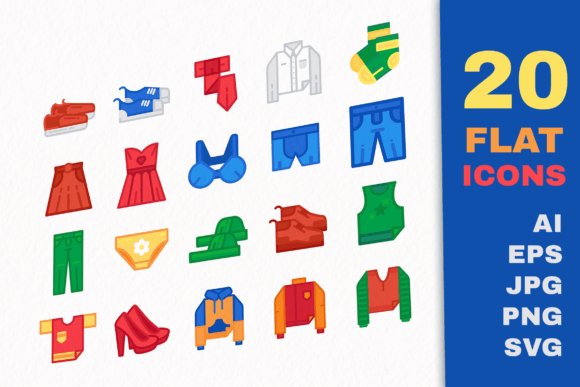
In the digital age, clarity and speed are everything. Whether you’re building an app, designing a website, or crafting a social media campaign, you need visual elements that communicate instantly. This is where a comprehensive set of Clothes Icons becomes more than just artwork—it transforms into a fundamental part of your workflow. A collection like the 20 Flat Clothes Icons Set, covering everyday items from shoes and dress to jeans, hoodie, and sneakers, is a versatile asset for creators across countless fields.
Beyond Fashion: Universal Applications for Clothing Symbols
At first glance, you might think these icons are solely for fashion brands or retail shops. While they’re perfect for those contexts, their utility stretches much further. The real power lies in their role as universal symbols. A pants icon isn’t just for a clothing store; it could represent a “laundry day” setting in a smart home app, or a “work attire” filter in a job-search platform. The tie symbol extends beyond menswear to signify “formal events” in a calendar app. This universal language of clothing allows designers to convey complex categories with simple, intuitive graphics.
Scenarios Where Ready-Made Icons Save Time and Money
Imagine you’re launching a new fitness application. You need to let users log their workout attire quickly. Instead of commissioning custom illustrations for sneakers, tank top, shorts, and socks, you integrate these pre-designed flat icons. They’re immediately recognizable, keeping the interface clean. Or consider an online dry-cleaning service creating a booking form. Using clear icons for shirt, dress, skirt, and jeans guides the user seamlessly through the service options, improving the user experience without lengthy explanations.
For social media managers, these icons are gold. Creating a story post about a “weekend wardrobe” or an infographic on “layering for fall” (using hoodie, sweatshirt, tank top symbols) becomes a matter of minutes, not hours. The consistent, clean style ensures brand coherence across posts. Even in print templates for a local gym’s promotional leaflet, icons for sneakers and shorts can break up text and highlight services visually.
Who Benefits from a Flat Clothing Icon Set?
The audience for this tool is remarkably broad. UI/UX designers use them to prototype and finalize interfaces for e-commerce, lifestyle, or service apps. Graphic designers employ them in branding materials, shop tags, and presentation slides. Marketing professionals embed them in promotional media and video animations to add visual cues. Small business owners with online shops can use them to categorize products without advanced design skills, thanks to the easy-to-edit vectors.
Furthermore, educators and consultants creating instructional materials find these symbols invaluable for creating clear, engaging content about textiles, retail, or everyday life skills. The unisex nature of the set—covering male, female, and neutral items like socks, slippers, and bras—makes it applicable for projects targeting any demographic, avoiding the need for multiple disparate icon packs.
Practical Considerations Before You Use Any Icon Collection
While a set like this offers immense value, smart application requires some forethought. First, consider style consistency. These icons feature a flat, simple, and clean design. Ensure this aesthetic aligns with your existing brand’s visual language. If your project uses highly detailed or 3D graphics, these flat icons might need stylistic adjustment.
Second, think about scale and format. This collection’s strength is its included file types (AI, EPS, SVG, PNG at multiple resolutions) for different use cases. SVG files are crucial for web and app development as they scale infinitely without quality loss. The PNG files with transparent backgrounds at 128px, 256px, 512px, and 1024px are ready for immediate use in digital projects. Always check you have the right format for your medium—vector files (AI, EPS, SVG) for editing and print, raster files (PNG, JPG) for fixed-size digital placement.
A third key consideration is comprehensiveness. Does the set have all the items you need? This 20-icon collection covers core wardrobe essentials, but if your project requires very niche clothing items, you might need to supplement it. However, for representing fundamental categories—underwear, briefs, pants, shirt, skirt, dress—it provides a solid foundation you can build upon.
Strengths and Real-World Flexibility
The highlighted features such as editable stroke, non-expanded vectors, and well-organized files speak directly to professional use. Being “easy to edit” means you can change colors to match your brand palette in seconds using Illustrator. The isolated icon structure lets you resize or modify individual elements without affecting others, a crucial factor when integrating icons into a complex layout or animation.
In practice, this flexibility is what turns a static asset into a dynamic tool. A web developer might use the SVG files to animate a shirt icon filling with color when a user selects it. A presentation designer could quickly recolor all the icons to monochrome for a sleek corporate slide deck. The 100 vector icons (from 20 base symbols across various file formats) ensure you’re equipped for both high-resolution print templates like brochures and tiny mobile app buttons.
One potential limitation to acknowledge is that while the style is versatile, it is specifically flat. If your project’s design trend demands skeuomorphic, isometric, or hand-drawn icons, this set would require significant stylistic alteration. However, the flat design trend remains dominant in digital interfaces for its clarity and modernity, making this collection a safe and contemporary choice for most projects.
From Idea to Implementation: Streamlining Visual Communication
Ultimately, investing in a well-crafted Clothes Icons collection is about streamlining communication. It replaces the need for verbose text labels with intuitive symbols, speeding up user comprehension. It saves countless hours of design resource time, allowing teams to focus on core functionality and content. For the individual entrepreneur or creator, it provides a professional visual toolkit that elevates their materials without a professional designer’s budget.
Whether your goal is to tag products in an online shop, design an interactive infographic about textile care, or build a clothing selection module in a game, these icons serve as a reliable, scalable, and adaptable visual foundation. They turn the abstract concept of “clothing categories” into a clean, actionable design element, proving that in design, sometimes the simplest tools—like a clear icon for a pair of jeans or a sneaker—are the most powerful.