The Digital Sketch: Unpacking the Power of the Pixel Silhouette Icon
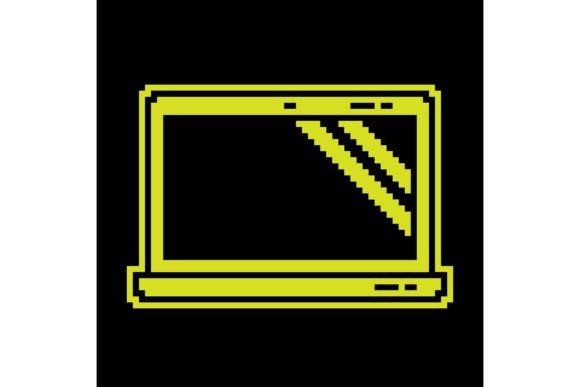
In the vast visual vocabulary of our digital world, icons serve as fundamental punctuation. Among this lexicon, one form stands out for its deceptive simplicity and immense utility: the laptop pixel silhouette icon. This is not merely a picture of a computer. It is a distilled representation, a conceptual anchor, and a versatile tool. Its minimal form—often a simple black outline against a bright yellow field—carries a weight of meaning that transcends its basic geometry.
The Anatomy of Abstraction: What Makes a Silhouette Icon
A laptop pixel silhouette icon is a specific type of computer pictogram. It reduces the complex physical object of a laptop to its most essential visual contours. The "pixel" reference often denotes a digital, clean, and slightly geometric style, reminiscent of early computer graphics or modern minimalist design, rather than a hand-drawn sketch. The silhouette removes internal detail, focusing solely on the outer shape. The common pairing of stark black with a vibrant yellow is a powerful design choice. Yellow, as a color, commands attention and is frequently associated with energy, ideas, and caution—all relevant to computing. This high-contrast combination ensures maximum visibility and instant recognition, which is critical for its primary functions.
Core Characteristics and Design Intent
The design intent behind these icons is clarity and universality. By stripping away brand-specific details like logos, keyboard layouts, or screen content, the icon represents the category "laptop" or "computer" in its purest form. This abstraction allows it to function across contexts without confusion. Whether used in an infographic about global tech adoption, a mobile app's settings menu, or a presentation slide about remote work, the symbol is immediately understood. The vector nature of these assets is another key advantage. As a vector graphic, the icon can be scaled infinitely without loss of quality, making it perfect for applications ranging from a tiny favicon on a website to a massive banner at a conference.
Primary Applications and Real-World Use Cases
The utility of the computer pictogram, laptop for infographics, extends far beyond mere decoration. Its primary role is communicative efficiency.
In user interface design, a simple black and yellow vector icon on a button might signify "device settings," "connect a computer," or "system diagnostics." Its neutrality is key here; it doesn't favor any particular operating system or manufacturer, making it ideal for cross-platform software.
For infographics and data visualization, these icons are indispensable. They act as visual metrics. Imagine an infographic about education technology: a row of ten laptop silhouette icons could represent "10,000 devices deployed in schools," using the icon as a repeatable unit. This transforms dry statistics into visually digestible information. Their simplicity prevents the graphic from becoming cluttered, allowing the data to remain the focus.
Presentation materials for business, education, or marketing heavily rely on such symbols. A slide discussing cybersecurity might use the icon to represent the endpoint—the user's device—that needs protection. In a pitch deck for a software solution, the icon can quickly establish the context of "desktop application" or "client hardware" without requiring a lengthy description.
Audience Relevance: Who Utilizes These Icons?
The audience for this visual tool is remarkably broad, mirroring the ubiquity of computing itself.
- Professional Designers and Developers: They incorporate these icons into UI/UX projects, websites, and application interfaces as functional elements.
- Business Owners and Marketers: They use them in reports, investor materials, and promotional content to visually signify technology infrastructure, digital services, or product compatibility.
- Educators and Researchers: In academic papers, lecture slides, or online course materials, the icon helps illustrate concepts related to digital literacy, computer-assisted learning, or research methodologies.
- Content Creators and Hobbyists: Bloggers, video producers, and DIY enthusiasts might use them in their own content to add clear, professional-looking visual cues without needing advanced graphic design skills.
- General Consumers: They encounter these icons daily in the interfaces of apps and websites they use, where they guide interaction and signify functions.
Advantages Over More Detailed Imagery
Choosing a laptop pixel silhouette icon over a photorealistic image or a detailed 3D render offers several distinct advantages. First is cognitive load reduction. A detailed image of a specific laptop model can distract the viewer with irrelevant details—"What brand is that? What year is that model?"—whereas the silhouette presents only the necessary concept: "computer." This speeds up comprehension.
Second is style consistency. The minimalist, vector-based style integrates seamlessly with modern flat design trends, data-driven infographics, and clean corporate aesthetics. It avoids the visual clash that can occur when placing a textured, realistic image into a minimalist design scheme.
Third is universal accessibility
When sourcing or creating a laptop silhouette icon for a project, several considerations ensure effective use. The silhouette accuracy is important. The outline should be recognizable as a laptop (with a distinct screen and base) and not be confused with a monitor or a tablet. The proportions matter. Color choice, while often black and yellow, can be adapted. The key is maintaining high contrast for visibility. In a dark-themed interface, a white silhouette on a dark blue field might be more appropriate. The color should align with the overall palette while preserving the icon's legibility. Contextual pairing is another vital consideration. Often, these icons are not used alone. They might be paired with a text label ("Laptop Settings"), combined with other icon elements (a silhouette with a wrench over it for "repair"), or sequenced in a process flow (a silhouette connected by a line to a cloud icon). Ensuring the icon's style matches the style of any paired elements is crucial for visual harmony. The pixel silhouette icon exists within a historical design context. Its "pixel" aesthetic nods to an era where graphics were defined by their constraints, yet this style has been re-appropriated for its clarity and digital-native feel. As technology evolves, so might the iconography. The fundamental laptop shape—a hinged screen and base—might persist, but we may see variations that hint at newer forms like foldables or ultra-thin devices. However, the power of the silhouette will remain. Its job is to represent an idea, not a specific product. Furthermore, in an age of metaphor-driven interfaces, the laptop icon serves as a stable, concrete anchor. Amid discussions of clouds, streams, blocks, and AI neural networks, the simple pictogram of the computer device grounds the user. It represents the tangible endpoint, the user's own machine, the final destination of data and the origin of commands. This conceptual stability makes it an enduring element in our visual language. In practical implementation, whether you are a designer embedding a simple black yellow vector into a new app's toolbar, a business analyst using a computer pictogram in a quarterly report slide, or an educator placing a laptop for infographics in a digital literacy guide, you are leveraging this abstraction. You are using a form that has been honed to its communicative essence. It bypasses the need for explanation, it standardizes visual reference, and it efficiently channels the viewer's attention to the larger point you are making about technology, access, process, or data. That is the real power hidden within the simple lines of the laptop pixel silhouette icon.Practical Considerations for Selection and Implementation
The Evolution and Future Context of Pixel-Based Pictograms
🔗 You Might Also Like