The Strategic Value of User Interface Icon Gradient Circular Sets
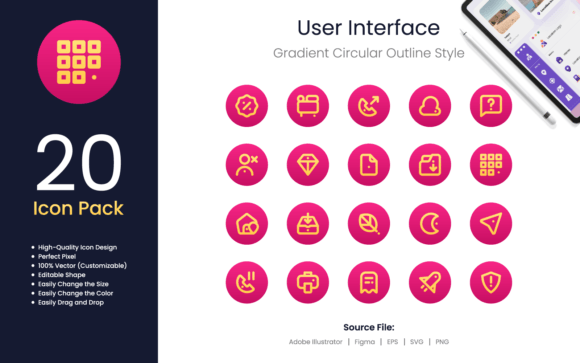
In a digital environment saturated with visual noise, the clarity and cohesion of your interface can be a decisive competitive advantage. A thoughtfully selected User Interface Icon Gradient Circular pack isn’t merely a collection of decorative graphics; it’s a foundational design asset. These icon sets, characterized by their rounded, contained shapes and smooth gradient outlines, offer a modern visual language that can unify disparate elements across your user touchpoints. For professionals looking to communicate functionality with elegance and consistency, understanding the strategic utility of these assets is the first step toward more intentional and effective design.
Beyond Decoration: Defining Intentional Use
What separates a random icon from a strategic one is intent. The User Interface Icon Gradient Circular style, with its enclosed circular frame and gradient outline, inherently provides structure. This containment creates a visual anchor, making icons feel part of a cohesive system rather than isolated symbols. This is crucial for user experience (UX), where recognizability and predictability reduce cognitive load. For your audience—whether they are customers navigating your app, visitors browsing your site, or colleagues viewing your presentation—this consistency translates into smoother interactions and a more polished perception of your brand.
The gradient element is not just a trendy aesthetic. Strategically, it introduces a subtle depth and dynamism without overwhelming the core symbol. It can guide visual hierarchy, drawing gentle attention to primary actions or statuses. When you deploy a User Interface Icon Gradient Circular set, you’re employing a tool that balances modern appeal with functional clarity. This makes it particularly valuable for projects aiming to project innovation and professionalism simultaneously.
Planning for Integration Across Channels
A key strategic benefit of a comprehensive pack lies in its multi-format offering. Receiving source files like Adobe Illustrator, FIGMA, EPS, and SVG means the icons are not static, final products but adaptable design components. This is essential for long-term planning. For entrepreneurs and marketers building a brand, having editable vectors allows the icon set to evolve alongside your identity. You can adjust colors to align with brand palette updates, resize without quality loss for new platforms, and ensure the same visual language appears on your website, mobile app, social media graphics, and printed flyers.
Considerations for Implementation
Before integrating a User Interface Icon Gradient Circular set, ask yourself several planning questions. First, what is the primary communication goal of the interface? Is it to simplify complex information (infographics), drive user actions (UI buttons), or enhance narrative flow (presentations)? Match the icon’s function to its style. The circular outline style excels at creating a clean, button-like appearance ideal for actionable UI elements.
Second, consider the existing visual context. Do the gradients complement or clash with your background colors and typography? The customizable nature of the pack is a strategic advantage here; you can modify the gradient stops or colors to achieve harmony. Third, think about scalability. Using the 100% vector source files ensures that the icons remain “perfect pixel” whether displayed on a retina screen or a large-format poster, protecting the quality of your output across all mediums.
Strategic Applications and Real-World Use Cases
Let’s explore where a User Interface Icon Gradient Circular pack moves from being a nice asset to a strategic one.
For mobile app developers, consistency in iconography across tab bars, settings menus, and feature indicators is paramount. The circular frame provides a uniform tap target area, improving usability. The gradient can be used to signify active versus inactive states, adding a layer of intuitive communication without extra text.
In website design, these icons can serve as powerful visual cues for service offerings, feature lists, or call-to-action sections. Their polished appearance lends credibility, while their scalability ensures they look sharp on any device. For a small business owner, using a cohesive set across their site’s “Our Services” section and their downloadable PDF brochures creates a professional, integrated brand impression.
Educators and creators producing infographics or presentation materials can use the icons to break down complex data into digestible visual points. The enclosed circular style keeps each symbol distinct, preventing visual clutter. The editable nature means they can color-code icons to match different data categories or themes, enhancing understanding.
Avoiding Common Pitfalls and Risks
The risk lies not in the icons themselves, but in their unconsidered application. Using a User Interface Icon Gradient Circular pack without clear goals can lead to a superficially attractive but functionally confusing interface. Icon overload, where every element is decorated, can diminish usability. Similarly, misusing the gradient—making it too harsh or contrasting—can defeat its purpose of subtle enhancement and become a distraction.
Another strategic oversight is neglecting the source files. If you only use the provided PNGs without accessing the vectors, you lose the long-term flexibility to adapt. You become locked into a specific size and color, which may not serve future projects or rebrands. The strategic approach is to treat the pack as a living component of your design library, not a one-time-use product.
Making Better Decisions with Your Design Assets
Intentional use begins with selection. A pack offering 20 icons in a unified style provides a sufficient foundation for many projects without being overwhelming. It encourages you to think in terms of a system. When planning a new interface or campaign, map out the key functions or messages you need to convey. Then, selectively assign icons from your User Interface Icon Gradient Circular set to those points. This exercise ensures each icon has a deliberate communicative role.
Think about longevity. The decision to invest in a vector-based, customizable set pays dividends over time. As your projects grow, you can reuse, resize, and recolor these assets, ensuring design consistency and saving resources. For freelancers and agencies, this builds a reusable asset library that increases efficiency and output quality across client work.
Finally, consider the operational ease. Features like “easily drag and drop” and multiple format inclusions are not just convenience features; they reduce friction in the creative process. This allows you, the professional, to focus on higher-level strategic tasks—like user journey mapping or brand storytelling—rather than struggling with technical design hurdles. The User Interface Icon Gradient Circular pack, when approached with this mindset, becomes a tool that supports both your immediate creative output and your long-term operational goals.
Conclusion: A Tool for Cohesive Communication
Ultimately, the value of a User Interface Icon Gradient Circular icon set is measured by its contribution to clearer communication and a more cohesive user experience. It is a strategic choice for those who recognize that design components are not isolated decorations but integral parts of a system that guides, informs, and influences perception. By selecting a high-quality, editable pack and planning its integration with clear goals, you empower yourself to create interfaces and materials that are not only visually compelling but also functionally robust. This thoughtful approach turns a simple set of icons into a lasting asset for branding, usability, and professional expression across all your digital and physical touchpoints.